
Close Menu
Retirement Financial Plan – Your Guide to a Secure Retirement

    Subscribe to Updates

    Get the latest creative news from FooBar about art, design and business.

    What's Hot

    I’m 59 With $1.7 Million Saved and Just Lost My Job. Should I Retire at 59½, or Find New Work?

    December 21, 2025

    What to Know Before Upgrading Your Samsung Galaxy Phone

    December 21, 2025

    4 Times to Say Yes to a Roth Conversion and 4 Times to Say No

    December 21, 2025
    Facebook X (Twitter) Instagram
    Trending
    • I’m 59 With $1.7 Million Saved and Just Lost My Job. Should I Retire at 59½, or Find New Work?
    • What to Know Before Upgrading Your Samsung Galaxy Phone
    • 4 Times to Say Yes to a Roth Conversion and 4 Times to Say No
    • The 4% Rule and Safe Withdrawal Rates
    • New Hearth & Hand Spring Collection
    • What’s next for airfares after ticket prices fell in November
    • Opinion: Threatening to fire employees is no way to get them on board with AI
    • Which Balance Transfer Credit Card Is Right for Me?
    Facebook X (Twitter) Instagram Vimeo
    Retirement Financial Plan – Your Guide to a Secure Retirement
    Sunday, December 21
    • Home
    • Budget & Lifestyle
    • Estate & Legacy
    • Retirement Strategies
    • Savings & Investments
    • More
      • Social Security & Medicare
      • Tax Planning
      • Tools & Reviews
    Retirement Financial Plan – Your Guide to a Secure Retirement
    • About Us
    • Contact Us
    • Privacy Policy
    • Terms and Conditions
    • Disclaimer
    Home » Mapping the Uneven Burden of Rising ACA Marketplace Premium Payments due to Enhanced Tax Credit Expiration
    Social Security & Medicare

    Mapping the Uneven Burden of Rising ACA Marketplace Premium Payments due to Enhanced Tax Credit Expiration

    troyashbacherBy troyashbacherNovember 13, 2025No Comments4 Mins Read
    Facebook Twitter Pinterest LinkedIn Tumblr WhatsApp VKontakte Email
    Mapping the Uneven Burden of Rising ACA Marketplace Premium Payments due to Enhanced Tax Credit Expiration
    Share
    Facebook Twitter LinkedIn Pinterest Email

    The Affordable Care Act (ACA) offers premium tax credits to help make health insurance more affordable. Under original Affordable Care Act provisions, an income cap for premium tax credits was set at 400% of the federal poverty level. Above that threshold, federal financial assistance was not available, creating a “subsidy cliff.” The American Rescue Plan Act (ARPA) and later the Inflation Reduction Act (IRA) temporarily expanded eligibility for tax credits to people with incomes over 400% of poverty, in addition to providing more generous support for people at lower incomes.

    Enhanced premium tax credits expire at the end of this year. Enrollees currently receiving premium tax credits at any level of income will see their federal assistance decrease or disappear if enhanced premium tax credits expire, with an average increase of 114% to what enrollees pay in premiums net of tax credits. Since premium payments are capped based on income and family size, there is little geographic variation in the resulting increases in premium payments for enrollees with incomes below 400% of poverty. Out-of-pocket premiums for people with incomes below 400% of poverty will increase by hundreds of dollars to over $1,500 per person on average.

    Among those with incomes over 400% poverty who are losing the tax credit altogether, the impact will be greatest for those whose unsubsidized premiums are highest: older Marketplace enrollees and those living in higher-premium locales. Among enrollees with incomes over 400% of poverty, just over half are between ages 50 and 64, and will therefore have high unsubsidized premiums.

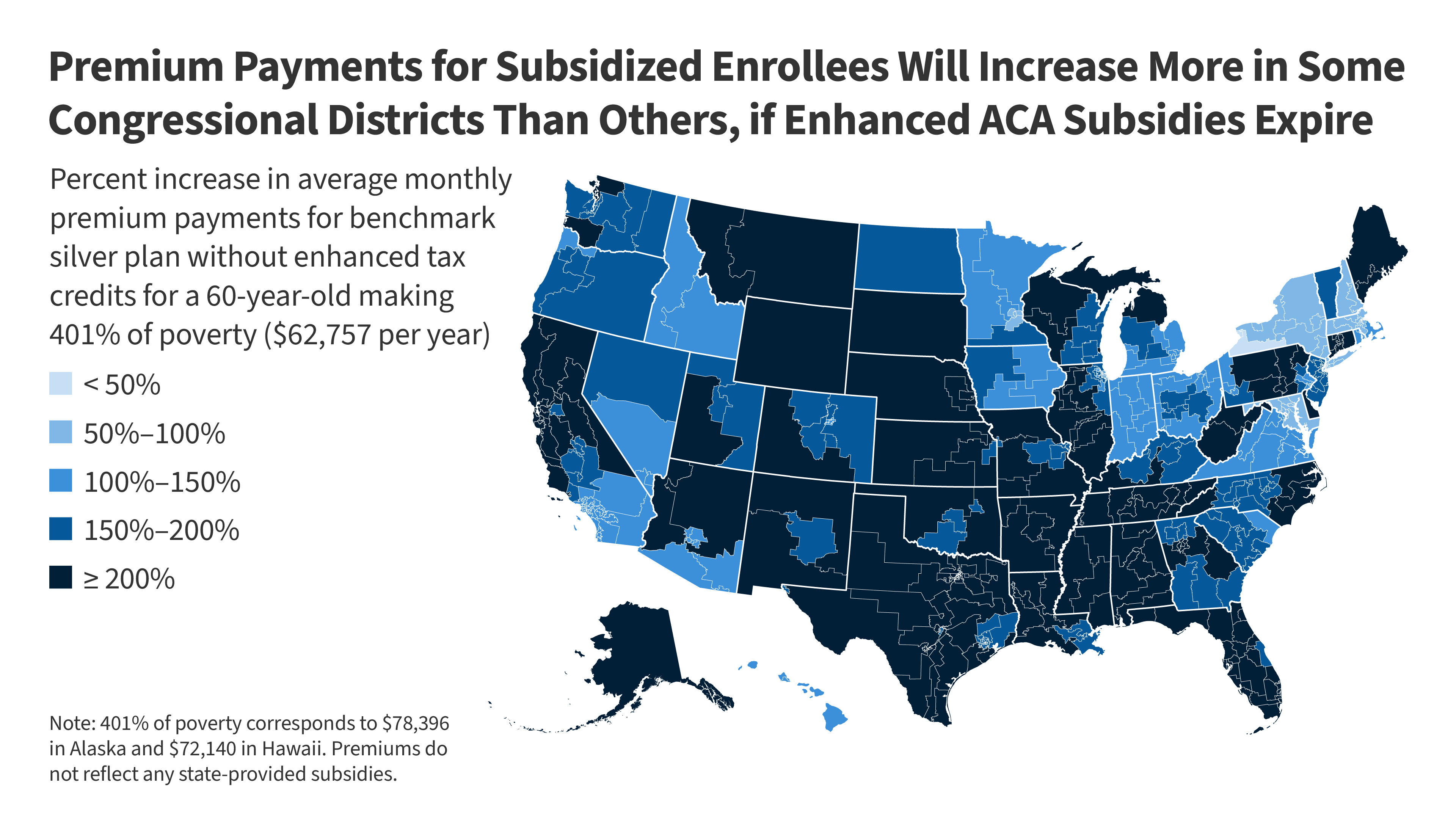
    The maps below show how much average premium payments would increase for 2026 benchmark silver plans with the expiration of enhanced premium tax credits at three income levels above an income cap of 400% of federal poverty for a 40-year-old and 60-year-old individual, namely 401%, 501% and 601%.

    Among these three income levels, enhanced tax credits provide the most financial assistance for those at 401% of poverty, which represents an annual salary of $62,757 for an individual in the contiguous United States. Because the cost of living is higher in Alaska and Hawaii, 401% of federal poverty is $78,396 and $72,140 for individuals there, respectively. In 46 states and the District of Columbia, a 60-year-old at 401% of poverty will see their average annual premium payment for a benchmark silver plan at least double without enhanced tax credits. In 19 states, this person would see their premium payment at least triple on average for a benchmark silver plan, consuming more than 25% of annual income. States with the highest premium payment increases due to expired enhanced tax credits for a 60-year-old at 401% of poverty purchasing a benchmark silver plan are Wyoming ($22,452 increase per year), West Virginia ($22,006), and Alaska ($19,636). The smallest increases caused by the loss of enhanced tax credits for what enrollees pay annually for the benchmark silver plan are in New York ($4,469), Massachusetts ($4,728) and New Hampshire ($4,877).

    At 501% of poverty ($78,407 in the contiguous U.S., $97,946 in Alaska, $90,130 in Hawaii), expiration of enhanced premium tax credits would at least double average premium payments for a benchmark silver plan in 37 states and the District of Columbia for a 60-year-old; at 601% of poverty ($94,057 in the contiguous U.S., $117,496 in Alaska, $108,120 in Hawaii), 19 states would see the average benchmark silver premium payments at least double for a 60-year-old if enhanced tax credits expire. The impact on a 40-year-old is more modest at all income levels.

    Existing premium differences lead to variation in premium payments with the expiration of the enhanced premium tax credits at the congressional district level as well. For people with incomes over 400% of poverty, there will be smaller premium payment changes for 40-year-old enrollees and larger changes for 60-year-old enrollees, for whom plans are more expensive.

    ACA Burden Credit due Enhanced Expiration Mapping Marketplace Payments Premium Rising Tax Uneven
    Share. Facebook Twitter Pinterest LinkedIn Tumblr WhatsApp Email
    Previous ArticleHow Staying With the Same Auto Insurer Can Raise Your Rates
    Next Article Buying Into a Practice, Building Wealth, and Planning Ahead
    troyashbacher
    • Website

    Related Posts

    Which Balance Transfer Credit Card Is Right for Me?

    December 20, 2025

    The year-end tax moves that can lower your tax bill and make your refund even bigger than Trump promised

    December 20, 2025

    14 Medicare out-of-pocket costs you should anticipate

    December 19, 2025

    Understanding Medigap’s Foreign Travel Benefits: What’s Really Covered?

    December 19, 2025
    Leave A Reply Cancel Reply

    Our Picks

    Goldman Sachs is pinning hopes on these consumers in 2026. Here are the stock picks.

    December 8, 2025

    Worried About an AI Bubble? Here Are BofA’s Top Stock Picks to Diversify Your Portfolio

    November 14, 2025
    • Facebook
    • Twitter
    • Pinterest
    • Instagram
    • YouTube
    • Vimeo
    Don't Miss

    I’m 59 With $1.7 Million Saved and Just Lost My Job. Should I Retire at 59½, or Find New Work?

    By troyashbacherDecember 21, 20250

    Question: I’m 59 with $1.7 million in savings and just found out my team is…

    What to Know Before Upgrading Your Samsung Galaxy Phone

    December 21, 2025

    4 Times to Say Yes to a Roth Conversion and 4 Times to Say No

    December 21, 2025

    The 4% Rule and Safe Withdrawal Rates

    December 21, 2025

    Subscribe to Updates

    Get the latest creative news from SmartMag about art & design.

    About Us

    Welcome to Retirement Financial Plan!

    At Retirement Financial Plan, our mission is simple: to help you plan, save, and secure a comfortable future. We understand that retirement is more than just a date—it’s a milestone, a lifestyle, and a new chapter in your life. Our goal is to provide practical, trustworthy guidance that empowers you to make smart financial decisions every step of the way.

    Latest Post

    I’m 59 With $1.7 Million Saved and Just Lost My Job. Should I Retire at 59½, or Find New Work?

    December 21, 2025

    What to Know Before Upgrading Your Samsung Galaxy Phone

    December 21, 2025

    4 Times to Say Yes to a Roth Conversion and 4 Times to Say No

    December 21, 2025
    Recent Posts
    • I’m 59 With $1.7 Million Saved and Just Lost My Job. Should I Retire at 59½, or Find New Work?
    • What to Know Before Upgrading Your Samsung Galaxy Phone
    • 4 Times to Say Yes to a Roth Conversion and 4 Times to Say No
    • The 4% Rule and Safe Withdrawal Rates
    • New Hearth & Hand Spring Collection
    Facebook X (Twitter) Instagram Pinterest
    • About Us
    • Contact Us
    • Privacy Policy
    • Terms and Conditions
    • Disclaimer
    © 2025 retirementfinancialplan. Designed by Pro.

    Type above and press Enter to search. Press Esc to cancel.