
Close Menu
Retirement Financial Plan – Your Guide to a Secure Retirement

    Subscribe to Updates

    Get the latest creative news from FooBar about art, design and business.

    What's Hot

    The 4% Rule and Safe Withdrawal Rates

    December 21, 2025

    New Hearth & Hand Spring Collection

    December 21, 2025

    What’s next for airfares after ticket prices fell in November

    December 20, 2025
    Facebook X (Twitter) Instagram
    Trending
    • The 4% Rule and Safe Withdrawal Rates
    • New Hearth & Hand Spring Collection
    • What’s next for airfares after ticket prices fell in November
    • Opinion: Threatening to fire employees is no way to get them on board with AI
    • Which Balance Transfer Credit Card Is Right for Me?
    • Gen Z would rather cut Social Security benefits for current retirees than pay higher taxes to save the program
    • The year-end tax moves that can lower your tax bill and make your refund even bigger than Trump promised
    • Financial To-Dos to Finish 2025 Strong and Start 2026 Stronger
    Facebook X (Twitter) Instagram Vimeo
    Retirement Financial Plan – Your Guide to a Secure Retirement
    Sunday, December 21
    • Home
    • Budget & Lifestyle
    • Estate & Legacy
    • Retirement Strategies
    • Savings & Investments
    • More
      • Social Security & Medicare
      • Tax Planning
      • Tools & Reviews
    Retirement Financial Plan – Your Guide to a Secure Retirement
    • About Us
    • Contact Us
    • Privacy Policy
    • Terms and Conditions
    • Disclaimer
    Home » Why (Most) Advisors Shouldn’t Serve As Clients’ Trustees: Ethical Conflicts, Dual Fiduciary Duties, And The SEC Custody Rule
    Retirement Strategies

    Why (Most) Advisors Shouldn’t Serve As Clients’ Trustees: Ethical Conflicts, Dual Fiduciary Duties, And The SEC Custody Rule

    troyashbacherBy troyashbacherNovember 12, 2025No Comments4 Mins Read
    Facebook Twitter Pinterest LinkedIn Tumblr WhatsApp VKontakte Email
    Why (Most) Advisors Shouldn’t Serve As Clients’ Trustees: Ethical Conflicts, Dual Fiduciary Duties, And The SEC Custody Rule
    Share
    Facebook Twitter LinkedIn Pinterest Email

    Financial advisors are used to having close and trusting relationships with their clients, given the advisor’s involvement in the intimate details of the client’s financial life and the long-term nature of many advisor-client relationships. And it therefore occasionally happens that a client asks their advisor to serve as trustee for a trust they’ve created. But while being asked to serve as a client’s trustee may be a testament to the depth of the relationship, advisors should think twice in most cases before accepting such an appointment. Because while no regulations outright prohibit advisors from acting as trustees, the ethical, fiduciary, and legal conflicts that accompany serving as a client’s trustee can often make it more trouble than it’s worth.

    At one level, advisors who act as both trustee and investment manager of a trust face an inherent conflict of interest, since they stand to benefit from the compensation they receive for managing the trust’s assets. Which isn’t necessarily prohibited under trust law, but does leave advisor-trustees open to having their decisions challenged by trust beneficiaries, where the advisor bears the burden of proving they acted reasonably and in good faith. Advisors must be prepared to demonstrate not only the prudence of their investment choices but also the fairness of their compensation arrangements with respect to the trust’s beneficiaries.

    Compounding this, conflicts can also arise from the dual fiduciary obligations advisors owe when a client is also a trust beneficiary. Advisors are bound to act in their clients’ best interests, but trustees must remain neutral among beneficiaries, which may be impossible to reconcile when not all trust beneficiaries are clients of the advisor. For example, if an advisor-client requests a distribution that another beneficiary opposes, the advisor-trustee must navigate a fiduciary gray area where impartiality is required but loyalty to the client is also expected.

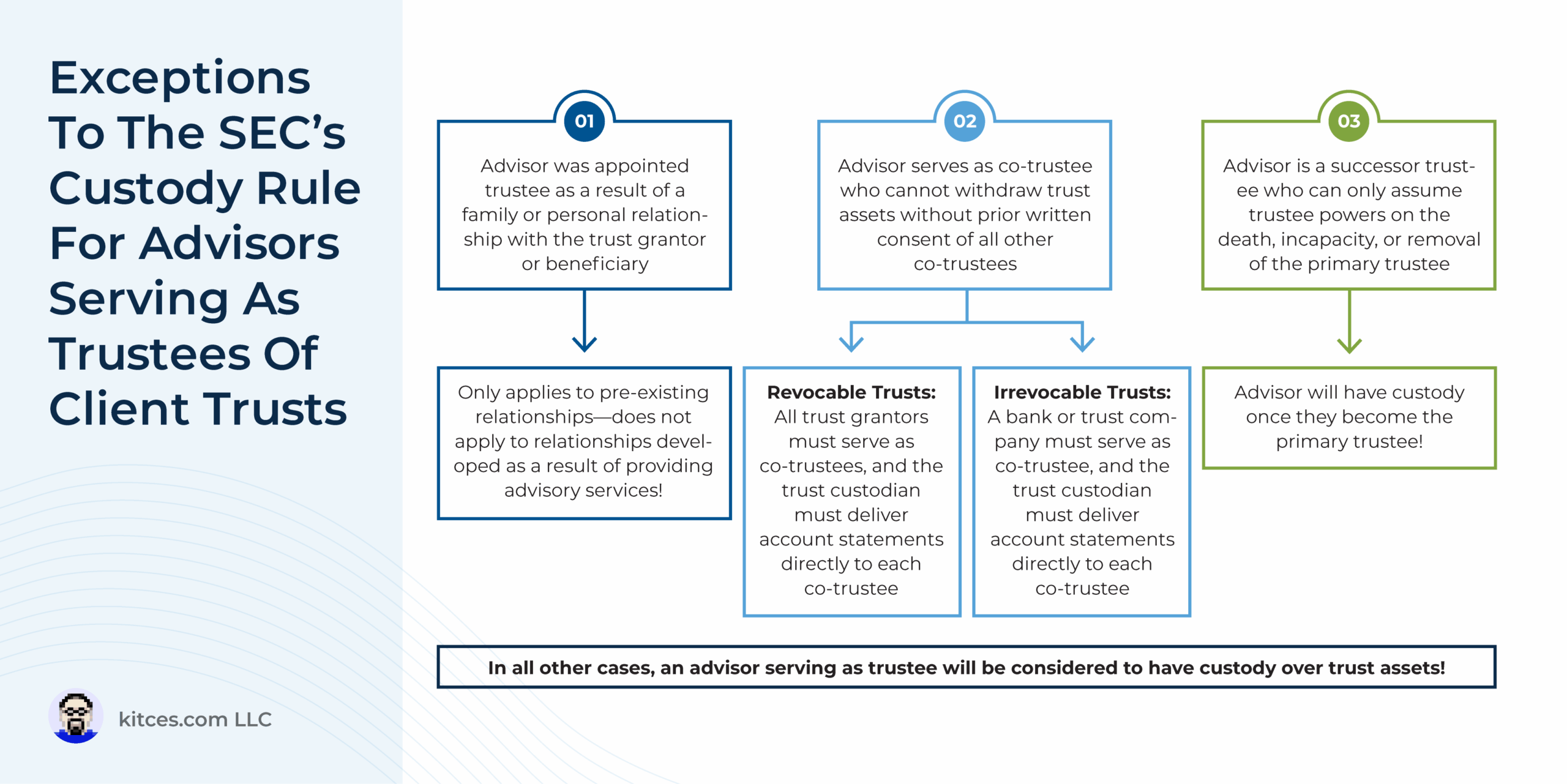
    Regulatory considerations further complicate the matter. Advisors who serve as trustees are generally deemed to have custody of trust assets by the SEC and state regulators, requiring annual surprise audits – a time-consuming and expensive process typically borne by the firm. While there are exceptions for close family relationships or co-trustee arrangements, these are narrow and often impractical. For RIAs, being named as a successor trustee (stepping in only upon a client’s death or incapacity) can temporarily avoid custody, but full compliance becomes necessary the moment the advisor assumes control of the trust. Similarly, broker-dealer representatives face their own hurdles, as FINRA rules require pre-approval and ongoing supervision from the broker-dealer firm before acting as a client’s trustee, adding yet another layer of oversight.

    Given these layers of complexity and risk, most advisors are better served by declining one-off trustee appointments unless they are prepared to offer trustee services as a structured, professional line of business. Advisors who pursue this route must establish clear client acceptance criteria, liability protection (including E&O coverage and legal entity structuring), and robust operational systems to fulfill their administrative and fiduciary responsibilities. These include managing distributions, tax reporting, beneficiary communication, and ongoing investment management. Done right, such a service can be a compelling value-add for high-net-worth clients who prefer a ‘one-stop shop’ for wealth and trust management, and can also serve as a differentiator in a competitive marketplace.

    Ultimately, the question of whether to serve as a trustee comes down to intentionality and infrastructure. Advisors who say yes must be fully equipped – legally, operationally, and ethically – to fulfill both roles without compromise. For everyone else, the more prudent path is to build strong referral relationships with qualified corporate trustees or attorneys who can fulfill that role, ensuring clients’ needs are met while protecting the integrity of the advisor-client relationship. Either way, the goal remains the same: to honor the immense trust clients place in their advisor by ensuring their wishes are carried out with competence, impartiality, and care!

    Read More…

    Advisors Clients Conflicts Custody Dual Duties Ethical Fiduciary Rule SEC Serve Shouldnt Trustees
    Share. Facebook Twitter Pinterest LinkedIn Tumblr WhatsApp Email
    Previous ArticleDow Climbs 327 Points, Crosses 48,000: Stock Market Today
    Next Article Be an American Nerd, Not the Cool Kid, If You Want to Survive
    troyashbacher
    • Website

    Related Posts

    The 4% Rule and Safe Withdrawal Rates

    December 21, 2025

    SPY vs. VOO: Which S&P 500 ETF Should You Choose?

    December 20, 2025

    How TIPS Fit Into a Thoughtful Retirement Income Plan

    December 19, 2025

    Danger: Households Have More Wealth in Stocks Than Real Estate

    December 19, 2025
    Leave A Reply Cancel Reply

    Our Picks

    Goldman Sachs is pinning hopes on these consumers in 2026. Here are the stock picks.

    December 8, 2025

    Worried About an AI Bubble? Here Are BofA’s Top Stock Picks to Diversify Your Portfolio

    November 14, 2025
    • Facebook
    • Twitter
    • Pinterest
    • Instagram
    • YouTube
    • Vimeo
    Don't Miss
    Retirement Strategies

    The 4% Rule and Safe Withdrawal Rates

    By troyashbacherDecember 21, 20250

    An important rule of thumb for the physician investor to understand is the 4% rule.…

    New Hearth & Hand Spring Collection

    December 21, 2025

    What’s next for airfares after ticket prices fell in November

    December 20, 2025

    Opinion: Threatening to fire employees is no way to get them on board with AI

    December 20, 2025

    Subscribe to Updates

    Get the latest creative news from SmartMag about art & design.

    About Us

    Welcome to Retirement Financial Plan!

    At Retirement Financial Plan, our mission is simple: to help you plan, save, and secure a comfortable future. We understand that retirement is more than just a date—it’s a milestone, a lifestyle, and a new chapter in your life. Our goal is to provide practical, trustworthy guidance that empowers you to make smart financial decisions every step of the way.

    Latest Post

    The 4% Rule and Safe Withdrawal Rates

    December 21, 2025

    New Hearth & Hand Spring Collection

    December 21, 2025

    What’s next for airfares after ticket prices fell in November

    December 20, 2025
    Recent Posts
    • The 4% Rule and Safe Withdrawal Rates
    • New Hearth & Hand Spring Collection
    • What’s next for airfares after ticket prices fell in November
    • Opinion: Threatening to fire employees is no way to get them on board with AI
    • Which Balance Transfer Credit Card Is Right for Me?
    Facebook X (Twitter) Instagram Pinterest
    • About Us
    • Contact Us
    • Privacy Policy
    • Terms and Conditions
    • Disclaimer
    © 2025 retirementfinancialplan. Designed by Pro.

    Type above and press Enter to search. Press Esc to cancel.